In his Nobel lecture, Alexander Solzhenitsyn quotes another his fellow Russian writer Dostoevsky who said, “Beauty will save the world.” It’s fascinating to me that someone who experienced so much darkness and ugliness in the gulag system would cling to such a quote.
Solzhenitsyn understood as few can the true power of the Good, the Beautiful, and the True. In his lecture to receive the Nobel prize for literature, he affirms the role of the artist in spotting and speaking in beauty even and especially in a tragically broken world:
“The task of the artist is to sense more keenly than others the harmony of the world, the beauty and the outrage of what man has done to it, and poignantly to let people know.”
In a world full of curated pictures for the gram and photoshopped beauty, I think the beauty that both my Russian writer friends speak of is of a whole different sort. Yes, the world will be saved by beauty, but not the fake, photoshopped kind. Rather, it will be saved by the wild and wounded kind of beauty that stems from the sacrificial love of Christ on the Cross. That is not to say that the task of the artist is to only write about Christ and his passion. No, all beauty that is true beauty will achingly point to the agony of the Savior with or without expressly talking about our Christ and his chosen cross.
Spotting Ordinary Extraordinary Beauty
Anyone with sight can see and speak of the beauty of a pastel-painted sunset. After all, such beauty is hard to miss. But spotting nuanced, subtle beauty is a slowly-learned skill, one that requires patience and awareness and imagination. I hear it is much like bird-spotting (which, if true, does not bode well for me, as I haven’t the patience for bird-spotting). Living in a world full of havoc and carrying about within me a heart prone to heaviness, I have to make a concerted effort to spot subtle beauty throughout my day.

This week, I saw the beauty of vulnerable courage in my son who struggles with a stutter. At his parent-teacher conference, we encouraged him to advocate for himself with a particular teacher who did not know why he did not participate readily by raising his hand often. I watched my nervous little boy bravely look his teacher in the eye and say, “I stutter sometimes.” I had to fight back tears in that moment because the ordinary beauty of his daily bravery took me aback. To struggle with the very stuff that our days that our days and worlds are made of (for words create worlds) is no small thing. To overcome the fear of opening one’s mouth even when the words might be halting is tremblingly beautiful.
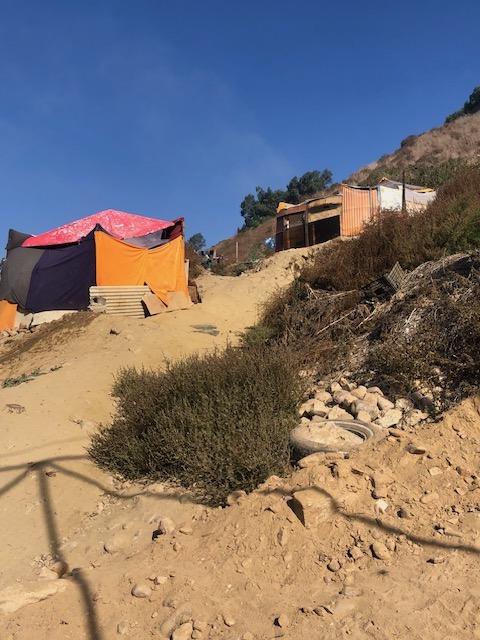
Last week, I saw the beauty of people learning to live together at the edges of their stories. I met a pastor who, by faith, turned his church into a shelter for 1600 asylum-seeking strangers. In that context, simple green mats stacked from floor to ceiling became beautiful. Pots and pans stacked in a newly built commercial kitchen finally able to feed such crowds were more beautiful in that moment than the Mona Lisa.
There exists a beauty more becoming because it stands against the brokenness of the world. And it is often lurking where we least expect to find it.
Speaking What We See
But seeing or spotting beauty is not enough. We must speak of what we have seen and heard. In a culture surrounded by superficial beauty, we long to hear others speak of the genuine, vulnerable beauty they see in and through us, as broken and weak as we are.
According to Curt Thompson in his book The Soul of Desire, it “takes less than three seconds for the neuroaffective effects of shame to register in the mind.” Yet, it “takes anywhere from thirty to ninety seconds for us to fully receive the emotional ‘load’ of a compliment, of a bid for attachment, of a gift of goodness or beauty directed our way.”
Thus, it takes intentional work both to see beauty and to be on the receiving end of someone speaking of the beauty seen. it requires relational vulnerability both to speak and to receive beauty spotting. The more subtle the beauty, the more vulnerability and courage required on both ends. When we were walking back to the car from the parent teacher conferences, my husband and I both took the time to celebrate our son’s beautiful, risky vulnerability with his teacher. The artwork he showed us in his classroom was beautiful, but we longed for him to know that even more tremblingly beautiful was his courage to steward his stuttering as part of his story.
It’s hard to see the beauty in our own lives; we often need outside eyes to behold it and beckon us to see it. Be those who stalk subtle beauty in its strange haunts and quickly speak of the beauty you’ve seen. Take the ten minutes to write a hand-written note. If you don’t have ten, take five to call someone and tell them the beauty you’ve seen. If you don’t have five, take two and send them a text to say that you’ve spotted beauty.
We are all starving for hints of the beauty of Christ who saved us. The world has been and will be saved by his beauty, but that Christ still, in the words of monk and poet Gerard Manley Hopkins, “plays in ten thousand places / Lovely in limbs, and lovely in eyes not his / To the Father through the features of men’s faces.” When you see hints of his beautiful, sacrificial love in the lives of others, speak it like our lives depend on it– because they do.
 aimeejoseph
Leave a comment