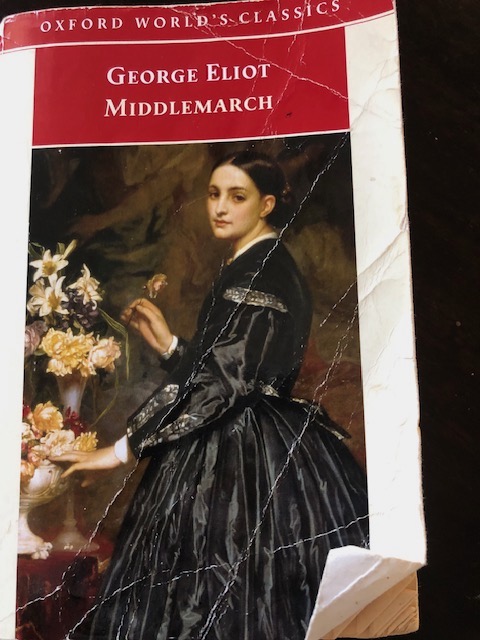
As a sophomore in college, I took a course called the British Novel wherein we were required to read books as thick as the bricks that lofted my dorm bed every week. Thanks to the feverish pace, I read but barely enjoyed most of the novels, with the exception of George Eliot’s Middlemarch. Even while reading it at rocket speed as a naive sophomore, I knew this novel was a treasure. More than twenty years later (as a mother of a sophomore in high school), I decided it was high time to reread Middlemarch at my soul’s chosen pace. I found, much to my enrichment, that it spoke to my soul in profound ways.
I love it when fiction strengthens my faith and sheds light on my everyday life. On a romantic note, the way that Will Ladislaw loved Dorothea (“Explain my preference! I never had a preference for her any more than I have a preference for breathing. No other woman exists by the side of her.”) gave me a visual picture of what I long for my boys to think about their future spouses. And it does not get cuter than Mary Garth and Fred Vincy’s relationship. But, even more than the romance, I was struck by the way Caleb Garth lived out a beautiful theology of faith and work.
Caleb Garth’s Passion for Work
In Middlemarch, Eliot paints a detailed description of layered life in a typical town in Victorian England. Among countless wealthy families settled on expansive estates, worrying about pleasantries and proper manners, we meet the hardworking Garth family. Though they lived back and forth over the poverty line, the Garth home and the interactions of their family provide, in large measure, the levity, joy, and beauty of the novel. At the heart of the Garths stands the patriarch, Caleb Garth, a lovable husband, tender-hearted father, and hard-working lover of industry.
According to Eliot, who interjects her own thoughts regularly as narrator, “He gave himself entirely to the many kinds of work which he could do without handling capital, and was one of those precious men within his own district whom everybody would choose to work for them, because he did his work well, charged very little, and often declined charge at all. It is no wonder, then, that the Garth’s were poor, and ‘lived in a small way.’ However, they did not mind it.”
Amid the greedy, money-grabbing hands of many other characters, Caleb stood out as the most free because of his love for work itself and the good it did not only to the land and to the effected families but also to the workers themselves. As Eliot reminds us regularly regarding Caleb, “It must be remembered that by ‘businenss’ Caleb never meant money transactions, but the skillful application of labor.” For the Garth family, work was its own reward.
Caleb sought to instill in his future son-in-law, Fred Vincy, the value of work you love. Fred’s family had paid exorbitant sums for an education that didn’t suit him, and he needed career coaching before he would be free to marry Mary Garth. According to Caleb, “The young ones always have a claim on the old to help them forward. I was young myself once and had to do without much help; but help would have been welcome to me.” He lived to pass on the wisdom and direction that the younger generation so desperately needed. He told Fred the following:
“You must be sure of two things: you must love your work, and not be always looking over the edge of it, wanting your play to begin. And the other is, you must not be ashamed of your work, and think it would be more honorable to you to be doing something else. You must have a pride in your own work and in learning to do it well…No matter what a man is–I wouldn’t give twopence for him….–whether he was the prime minister or the rick-thatcher, if he didn’t do well what he undertook.”
I cannot think of more apt bits of advice for our present age than these. In a culture that measures success by the rungs climbed on corporate ladders and dollar bills, we need bold Caleb Garths who teach us a different measure for success and a better way of determining calling. We need older mentors who come alongside the young who are utterly paralyzed by the menu-items of choices set before them. Amid the loud voices of social media and celebrity culture, we need the quiet voices of those who come alongside us and teach us the value of calling (as Buechner described it, “the place where your deep gladness and the world’s deep hunger meet”).
The value of living within our God-given callings and living out of God-given passions makes us rich spiritually even if it doesn’t promise to do the same financially. Though he was poor,Caleb Garth was the richest character in all of Middlemarch. Oh, how I long to be more like him.
 aimeejoseph
Leave a comment