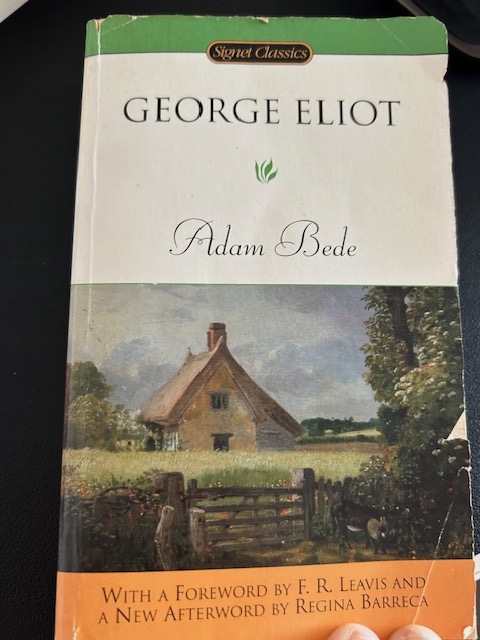
In a Brit Lit course in college, I read Middlemarch and promptly became a dedicated George Eliot fan. Every year, I seek to read or reread one of her novels. This year’s pick was Adam Bede, one of her earliest novels about a hard-working and upright carpenter who finds himself in a crooked, tangled love situation. As I’ve come to expect in Eliot’s classic novels, my faith was strengthened through her fiction. If I had to whittle it down to four main areas where I found gospel truths hidden in her storytelling, they would be the intersection of faith and work, the necessity of community, the power of forgiveness, and the hidden gift of suffering.
The Intersection of Faith & Work
The reader is first introduced to Adam Bede at work, deep in wood shavings and conversation about the Methodist revival with his coworkers. Adam’s thoughts regarding the deep spirituality of work speak to the modern reader and cut through the same pervasive sacred/secular divide:
“I know a man must have the love o’ God in his soul, and the Bible’s God’s word. But what does the Bible say? Why, it says, as God put his sperrit into the workman as built the tabernacle, to make him do all the carved work and things as wanted a nice hand. And this is my way of looking at it: there’s the sperrit o’ God in all things and at all times– weekday as well as Sunday– and i’ the great works and inventions, and i’ the figuring and the mechanics. And God helps us with our headpieces and our hands as well as with our souls; and if a man does bits o’ jobs out o’ working hours…he’s just as near to God.”
After both his father’s death and the devastation of a lost love, Adam finds solace in the work of his hands. Giving himself to work gave him time and space to grieve.
“There’s nothing but what’s bearable as long as a man can work…the natur o’ things doesn’t change, though it seems as if one’s life was nothing but change. The square o’ four is sixteen, and you must lengthen your lever in proportion to your weight, is as true when a man’s miserable as when he’s happy; and the best o’ working is, it gives you a grip hold o’ things outside your own lot.”
Though centuries of distance and cultural difference divide us from Eliot’s English countryside settings, her grip on the intersection of faith and work speaks even more loudly in our present culture with warped values of work.
The Necessity of Community
Adam’s hopes for marriage to Hetty are completely derailed by the careless love affair between she and Arthur Donnithorne, a wealthy landlord with little care for her future. This double betrayal exposes some weak points in the otherwise solid character of Adam Bede. His righteous anger at Donnithorne nearly devolves into an unrighteous spirit of vindication and revenge, and likely would have, had it not been for the faithful presence of friends willing to speak the truth and reorient his spinning soul towards truth.
Mr. Irwin, the village parson and Adam’s confidant, boldly but gently reminded Adam the doubled drama he would cause if he followed his feelings towards vengeance:
“There again, you partly deceive yourself, Adam. There is no sort of wrong deed of which a man can bear the punishment alone; you can’t isolate yourself and say that the evil which is in you shall not spread. Men’s lives are as thoroughly blended with each other as the air they breathe: evil spreads as necessarily as disease. I know I feel the terrible extent of suffering this sin of Arthur’s has caused to others; but so does every sin cause suffering to others besides those who commit it. An act of vengeance on your part against Arthur would simply be another evil added to those we are suffering under; you could not bear the punishment alone; you would entail the worst sorrows on everyone who loves you.”
With gentle truths smacking of Scripture (Romans 12:17), Mr. Irwin addresses Adam’s flesh and helps him to walk by the Spirit. Adam’s former teacher says less but stays close to his former pupil in the moments of his deepest need. The two beautifully model the significance of community in the Christian life, especially in the valleys of trial. While Arthur Donnithorne was clearly richer monetarily, Adam is rich in relationships which anchor him to truth and help to hold his soul in life.
The Power of Forgiveness
Largely due to these friends, Adam finds his way out of blinding hatred and anger and into the spaciousness of forgiveness towards Donnithorne who destroyed so much of what Adam loved. In a meeting in the woods reminiscent of the meeting of Jacob and Esau after so many years and so much pain, Adam extends biblical forgiveness to a much-changed Arthur. In that exact wooded spot eight months earlier, Adam had refused to shake Arthur’s hand after learning of his love affair with Hetty; however, at this meeting in the woods, after so much irreparable harm had been done, he chose to extend forgiveness in the form of a handshake.
He admitted his harshness and his hard-heartedness, saying, “God forbid I should make things worse for you, I used to wish I could do it, in my passion– but that was when I thought you didn’t feel enough.”
Eliot as narrator shows and tells the beauty of forgiveness:
“The hands were clasped once more, and Adam left the hermitage, feeling that sorrow was more bearable now that hatred was gone.”
In our cancel culture world accustomed to nursing offenses, Adam Bede offers a fictional glimpse into the compelling beauty of Christ-like forgiveness.
The Hidden Gift of Suffering
Like Eliot, Dinah, the Methodist preacher who plays a powerful and stirring role throughout the entire book, both shows and tells the beauty of redemptive suffering. Choosing consistently to serve others at great sacrifice to herself, Dinah displays the radiance of redemptive suffering. Death to her means life to others, which ultimately gives more life to her.
I wont’ spoil the book, because I certainly hope you’ll read it yourself; however, I will share a small snippet of Dinah’s insights into the role of suffering in the life of a believer:
“Ah, that is a blessed time, isn’t it, Seth, when the outward light is fading,, and the body is a little wearied with its work and its labour. Then the inward light shines the brighter, and we have a deeper sense of resting on the Divine strength… that is a blind self-seeking which wants to be freed from the sorrow wherewith the whole creation groaneth and travaileth. Surely it is not true blessedness to be free from sorrow, while there is sorrow and sin in the world; sorrow is then a part of love, and love does not seek to throw it off.”
Fiction strengthens faith, and our faith always needs strengthening. Happy reading, my friends!
 aimeejoseph
Leave a comment